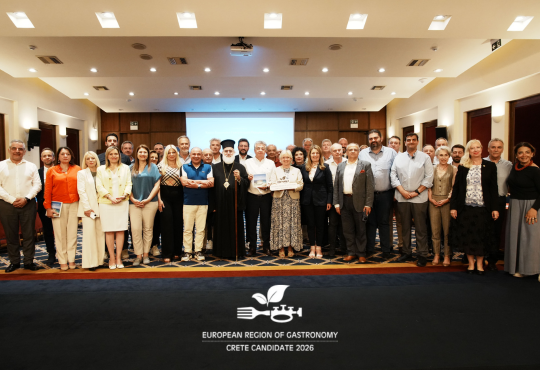
An international jury comprising four experts, accompanied by IGCAT’s President, Diane Dodd, PhD, evaluated the application of the Crete region for the title of European Region of Gastronomy 2026. After reviewing the bid book, Crete: Experience the Gastronomic Magic of Simplicity submitted on December 5, 2023, the jury visited the region from May 27-31, 2024. The purpose of the visit was to assess the region’s suitability and readiness to host the title in 2026. The jury will prepare a comprehensive report with recommendations to support the region’s journey.
During the visit, the jury met with over 60 stakeholders from across the islands, including associations of municipalities, regional government representatives for agriculture, culture and heritage, chefs, academics, business representatives, educators, and local entities concerned with the development and protection of Crete as a gastronomic region. The jury was pleased to engage with so many stakeholders from public, private, third sector, and academic institutions and commended the efforts of all involved in developing strategies and plans for the region.
General comments
The Jury was impressed by how the vision for Crete, Candidate European Region of Gastronomy 2026 is so closely linked with IGCAT’s focus areas and it also noted how that vision has been inspired and reinforced by Ploigos Education and Development Company’s longstanding and far-reaching work in the region. The work of Ploigos has been exceptional in this regard and it provides a clear roadmap for multiple sectors to work together to ensure a sustainable food future for Crete and to contribute to an excellent European Region of Gastronomy.
The Jury applauds the fact that Ploigos for decades has been working to boost local and regional development through research, education and training, bringing different stakeholders together to support small scale food production, Crete’s circular economy and at the same time strengthen the common gastronomic identity of Crete. The jury were happy to note that their philosophy aligns perfectly with IGCAT’s vision.
While the Jury couldn’t visit the whole of Crete, jury members were able to speak to representatives from the Region of Crete and the jury wish to congratulate the Region for their numerous excellent initiatives to safeguard and promote local cuisine.
The jury noted the exceptional work of the Agronutritional Cooperation of the Region of Crete and their ‘Crete – Land of Values’ certification scheme which identifies high quality, healthy local products and supports their availability in local restaurants, hotels and shops.
The Jury also had the opportunity to either visit or meet with representatives from many municipalities, villages and prefectures and wishes to congratulate all for their dedication to gastronomy, quality food and culture, also noting that their current activities and future plans to further elevate local gastronomy, align with the ambitions of the European Region of Gastronomy title.
The jury also acknowledge the excellent work of:
- Anogia Municipality
- Prefecture of Lasithi
- Municipality of Agios Nikolao
- Municipality of Sitia
- Kritsa village
- Krana village
- Rethymnon
- Vamos village
- Plaka village
- Elounda village
- Heraklion Municipality (UNESCO City of Gastronomy)
- Regional Union of Municipalities of Crete (PED)
- Psiloritis UNESCO Global Geopark.
The jury enjoyed seeing how local communities are appreciating, linking and connecting heritage, tangible and intangible, especially those which are promoting the rich inner countryside, the hinterland, of Crete, by developing new economic opportunities, starting from local traditions and recuperating knowledge. This was particularly evident at:
- the Shepherd’s Place interpretation centre; a true keeper of the Cretan rural heritage – and the exceptional strategies undertaken by A.K.O.M.M. and S.A. O.T.A. (Developmental Company of Psiloritis)
- the Shepherd’s Shelter (Mitato) in Krana village, where visitors can see the full cheese making process from milking to tasting Kalitsounia fried pies.
The jury supports the development of events because the linkage to live music, dance and theatre not only supports the performing arts sector in Crete but it provides memorable experiences and a reason to visit. The jury saw and heard about exceptional examples as in:
- The Carob Mill Art & Cultural Centre (Haroupomylos) where the jury got to know about the efforts of Epimenides Cultural Society of Panormo to protect, showcase and maximise the potential of the carob tree.
- Fabrica Farm & Houses in Vamos village who have been keeping rural traditions alive and sharing them since 1985
- Cretan Women in Business Association’s work on the revival of traditional arts and crafts
- Xobli Women’s Weaving Cooperative, a social enterprise promoting and teaching traditional weaving
- Hermioni for demonstrating traditional weaving in Perahori.
The jury encourages the development of educational itineraries within Crete and also, with international partners, because these stimulate exchange of knowledge as well as cross-marketing of food destinations, such as:
- Epimenides Cultural Society of Panormo’s proposal to build a «Carob Route» connecting different regions in the Mediterranean area.
- Archaeological Museum of Heraklion, a member of the Iter Vitis Cultural Route of the Council of Europe, where visitors can be guided through the ancient origins of the Cretan food and wine tradition, and appreciate the archeological remains from the Minoan civilization linked to wine production, food preparation and consumption.
The jury also used the occasion to express their support for Spinalonga island’s application for UNESCO World Heritage.
A conversation with International Documentary Festival of Ierapetra explored potential collaborations with IGCAT’s International Food Film Menu, aiming to promote Cretan gastronomy through food films.
Finally, the jury noted that their overall experience in the areas of culture, citizen involvement, empowerment, and heritage was one of strong evidence of social cohesion, community empowerment, of women leaders in society and in successful entrepreneurial initiatives, of authenticity – which is strong if you still have it, but once lost will be difficult to retrieve.
The Cretan contemporary way of life is typical of island communities, strong, resilient and persevering and recognising opportunity. The hospitable and evident autonomous identities of its people is a result of it history, its geographic location in the Mediterranean, and its will to forge sustainable social, environmental and economic Cretan futures.
The jury has been hugely impressed by cross-sectoral collaborations with the academic sector to identify, verify and research practical solutions, as witnessed the work of:
- University of Crete
- Department of Nutrition and Dietetics of the Hellenic Mediterranean University
- Mediterranean Agrofood Competence Centre (MACC)
- Mediterranean Agronomic Institute of Chania – MAICH
The Cretan Diet recognised by research as one of the healthiest diets and the Mediterranean Diet recognised by UNESCO as intangible cultural heritage are indeed huge assets.
Research, preservation and promotion of local cuisine and products involves key stakeholders, and the jury was pleased to note that researchers went to the farms. The importance of the primary sector (farmers and fishermen/women), who shape landscapes and have a key role in preserving the local products & biodiversity are as important as, restaurants, hotels, and consumers (local & tourists).
The jury was deeply impressed by the Foundation for Research and Technology – Hellas (FORTH) and Science and Technology Park of Crete (STEP-C), these research hubs are a catalyst for innovation and entrepreneurship, connecting the academic environment and the business sector, offering research services and technology solutions for start-ups and companies in many different sectors. The Jury had the opportunity to hear presentations and visit some of the Foundation’s facilities and labs, witnessing outstanding examples of how scientific research and state-of-the-art technologies can be applied to sustainable agriculture, agrofood, heritage preservation, visitor experiences and tourism. The jury was particularly impressed that school pupils can visit the labs and participate in experiments to encourage future young researchers.
Also, the jury appreciated the work of Agricultural Cooperative of Rethymno and Agroxenia (Union of Agrotourism in Greece).
The jury’s conversations with many experts, researchers and academics covered many important topics and current challenges such as the risks posed by increasingly globalised diets and climate change that can be averted by promoting sustainable agricultural practices, organic farming, conservation of local plant and animal varieties, and revival of traditional food ways and know-how.
The jury noted the Heraklion Hoteliers Association’s efforts to integrate local gastronomy into hotels by offering a Cretan breakfast and connecting guests with local producers through unforgetible memories. The jury wished to thank specifically for the hospitality and generosity during the visit:
- Olive Green Hotel
- Avli Restaurant in Rethymnon,
- The Association of Winemakers,
- Fabrica Farm & Houses
- Women Association of Kritsa, an organisation dedicated to safeguarding and giving visibility to local traditional gastronomy
- Kanali Restaurant in Elounda village
- Ligo Krasi, Ligo Thalassa restaurant
- kafeneio Aivaliotis
All inspiring hospitality businesses that are encouraging and boosting Cretan diet and providing the most tailored and beautiful experiences for everyone. The jury however, singled out Peskesi restaurant, stating that they deserved a special mention as they work for 0 food waste and circular economy, showcasing didactic resources as illustrative graphics for guests. This restaurant clearly understands their educational potential and their role in recovering plant/animal varieties and recipes. Their attention to detail: concepts, principals, practices, values, service, dishes, food and Maitre d’ were all exceptional!
On this note, the jury wishes to thank all individuals, experts and ambassadors, whose collective efforts have significantly contributed to establishing Crete as an authentic and distinguished European gastronomic destination, listed below in the order the jury met them:
Haris Roditakis, President, Educational Development Company Ploigos
Giorgos Zervos, General Manager, Educational Development Company Ploigos
Eirini Makedona, Project Curator, Educational Development Company Ploigos
Stella Lazari, Project Administrator, Educational Development Company Ploigos
Areti Alexaki, Educational Development Company Ploigos
Iraklis Apladas, Educational Development Company Ploigos
Vaso Kalenti, Educational Development Company Ploigos
Giannis Ktistakis, Educational Development Company Ploigos
Chalient Tachir, Educational Development Company Ploigos
Panagiotis Magganas, owner, Peskesi Restaurant
Michalis Kampitakis, representative, Association of Sultana producers in Crete
Maria Pitsikaki, representative, Cretan Women in Business Association
Menelaos Mpokeas, representative, Regional Union of Municipalities of Crete (PED)
Georgia Milaki, Deputy Governor in the field of Culture and Equality, Region of Crete
Eirini Choudetsanaki, President, Agronutritional Cooperation of the Region of Crete
Sokratis Kefalogiannis, Mayor, Municipality of Anogia, and President, A.K.O.M.M. – Psiloritis Anaptyxiaki S.A. O.T.A. (Developmental Company of Psiloritis)
Evi Vrentzou, Municipality of Anogia
Chrissa Daskalaki, President, Directorate General for Development Programming of Region of Crete
Chara Papailiou, Psiloritis Unesco Global Geopark
Alexandros Κοutalas, General Director, Agricultural Cooperative of Rethymno
Αndreas Kokkinos, owner, The Shepherd’s Shelter (Mitato)
Giorgos Nikolakakis, Associate Professor of Social Anthropology, University of Crete, and member, Crete, candidate European Region of Gastronomy Scientific Committee
Κorina Miliaraki, owner, Haroupomilos (Carob Mill), and Director, “Epimenides” Cultural Society of Panormo,
Charalampos Katerinopoulos, Emeritus Professor of Chemistry, University of Crete, and member, “Epimenides” Cultural Society of Panormo
Katerina Xekalou, owner, Avli Restaurant
Vasilis Leonidou, Chef, Avli Restaurant
Nikos Frantzeskakis, President, Agroxenia (Union of Agrotourism in Greece), Owner of Fabrica Farms & Houses and Ambassador, Crete, candidate European Region of Gastronomy
Lola Frantzeskakis, Fabrica Farms & Houses
Zaharenia Rikounaki, Mediterranean Agronomic Institute of Chania (MAICh), and member, Crete, candidate European Region of Gastronomy Scientific Committee
Georios Fakotakis, Mediterranean Agronomic Institute of Chania (MAICh), and member, Crete, candidate European Region of Gastronomy Scientific Committee
Nick Skoutelis, Professor, Technical University of Crete
Giannis Androulakis, Deputy Regional Governor, Prefecture of Lasithi
Manousos Pediaditis, Deputy Mayor of Culture, Tourism and Local development, Municipality of Agios Nikolaos
Giorgos Zervakis, Mayor, Municipality of Sitia
Vassilios Raikos, Associate Professor, Department of Nutrition and Dietetics Sciences, Hellenic Mediterranean University (HMU)
Evangelia Bakinda, President, Cretan Women in Business Association
Nikos Fountoulakis, General Manager, Heraklion Hoteliers Association
Nadia Tamiolaki, Vice-President, Heraklion Hoteliers Association
Μaria Simeaki, President, Women Association of Kritsa
Maria Tzortzi, President, “Xobli” Women’s Weaving Cooperative
Odysseas Sgouros, Architect
Eleni Vlasi, Culture Counsellor, Prefecture of Lasithi
Giorgos Papamichail, Director, Science & Technology Park of Crete (STEP-C), and and member, Crete, candidate European Region of Gastronomy Scientific Committee
Asterios Leonidis, Post-doctoral research assistant, Institute of Computer Science
Christos Stratakis, Technical Scientific Personnel, Institute of Computer Science
Panagiotis Sarris, Professor, Institute of Molecular Biology & Biotechnology
Yiannis Kamarianakis, Principal Researcher, Institute of Applied & Computational Mathematics
Michalis Velegrakis, Researcher Emeritus, Institute of Electronic Structure & Laser
Michalis Katharakis, CEO, Mediterranean Agrofood Competence Center (MACC)
Giorgos Agrimanakis, Deputy Mayor of Tourism, Municipality of Heraklion – UNESCO City of Gastronomy 2023
Despoina Dialyna, Municipality of Heraklion – UNESCO City of Gastronomy 2023
Maria Kassotaki, Region of Crete
Stavros Tzedakis, Deputy Governor of Rural Economy, Region of Crete
Eleni Maragkaki, Social – Eco – Cultural Organizations Network of Hersonissos
Katerina Athanasaki, Archaeologist and Head of Department of Exhibitions, Education and Public Relations, Archaeological Museum of Heraklion
Stella Chryssoulaki, Archaeologist and General Director, Archaeological Museum of Heraklion
Theano Vrentzou-Skordalaki, President, Local Management Committee of Asterousia (MAB/Unesco)
Nikos Sofronas, Head, Financial Services Department, Regional Development Fund of Crete
Stavros Arnaoutakis, Governor, Region of Crete
Roxane Vlami, Interpreter
Pefko Cafe at Plaka village
Kanali restaurant
Ligo Krasi, Ligo Thalassa restaurant
Kafeneio Aivaliotis
Olive Green Hotel
Atlantis Hotel
The jury wishes to note that the Award will give extra stimulus for the stakeholders to continue and deepen their cooperation; share knowledge and cross-marketing opportunities with other awarded and candidate Regions of Gastronomy, thus providing international visibility.
Recommendation
The jury appreciated that the bid:
- integrates the six different focus areas of IGCAT;
- includes multiple stakeholders and many more will participate going forward;
- integrates plans for Crete’s participation in IGCAT joint projects that show a commitment to the European dimension;
- presents a long-term lasting legacy for the region;
- shows a strong commitment from the regional partners to sustainability and quality food products;
The jury agreed that the exceptional food and hospitality found in Crete, the culture and indeed harmony of culture, heritage and well-being makes Crete’s application extremely strong.
Therefore, based on the written application and visit to the region, the jury decided that Crete should be recommended for the title European Region of Gastronomy 2026.
The jury will submit in the coming weeks their recommendations to the region and IGCAT will approve this recommendation at the next IGCAT Advisory Forum scheduled for 26 June 2024.
The jury very much hopes to see preparations unfold for the region’s Award Ceremony this year, which will be an opportunity to share Crete’s food treasures with the world.
Jury composition
Dr. Diane Dodd, IGCAT President accompanied the independent jury to ensure that all financial, governance and legal aspects will ensure a long-term legacy for the region.
The independent jury members were:
Dr Edith M Szivas, IGCAT Vice-President and expert on tourism focussed her attention on creativity, tourism and job opportunities as well as public sector governance;
Davinia Galea, from Gozo, candidate European Region of Gastronomy 2026 and IGCAT Expert on Culture, focussed her attention on culture, citizen engagement, empowerment and heritage initiatives;
Ramon Sentmartí, from Catalonia, European Region of Gastronomy 2016 / World Region of Gastronomy 2025 as well as an IGCAT Ambassador with expertise in in the Agrofood sector, focussed his attention on research, innovation, communication, marketing, legacy and evaluation;
Jaume Gomila, Menorca, a biosphere reserve and European Region of Gastronomy 2022, focussed his attention on environment, hospitality and sustainability.
About the World/ European Region of Gastronomy Award
The International Institute of Gastronomy, Culture, Arts and Tourism (IGCAT) is the operative institute that oversees the management and coordination of the World and European Region of Gastronomy Award. IGCAT believes that cross-sectoral collaboration will help regions find solutions to current day challenges and thus, the Award is not only given because a region has great gastronomy but because the whole region is working together to create a more sustainable food future. IGCAT encourages not only hospitality industries to participate but everyone across the whole eco-system including public, private, NGO and academic institutions.
The first step in applying for the Award is to bring these different entities together. The next stage is to create a bid book that pulls together as many great initiatives as possible so that people within the region themselves can begin to appreciate how rich their resources are. The third stage is a jury visit that concludes with a recommendation for IGCAT Board and a report to help the region in preparing a successful journey.
Candidate and awarded Regions of Gastronomy, guided by IGCAT, are working together to strengthen food security through the celebration of distinctive food cultures; create employment by stimulating creativity and gastronomic innovation; nourish children and adults through culinary and cultural education; drive environmental sustainability in tourism, hospitality and agricultural sectors; support balance and sustainable tourism practices; highlight and support expertise from within rural and urban communities, creating connections and sharing good practises; and ultimately they contribute to community health and well-being.