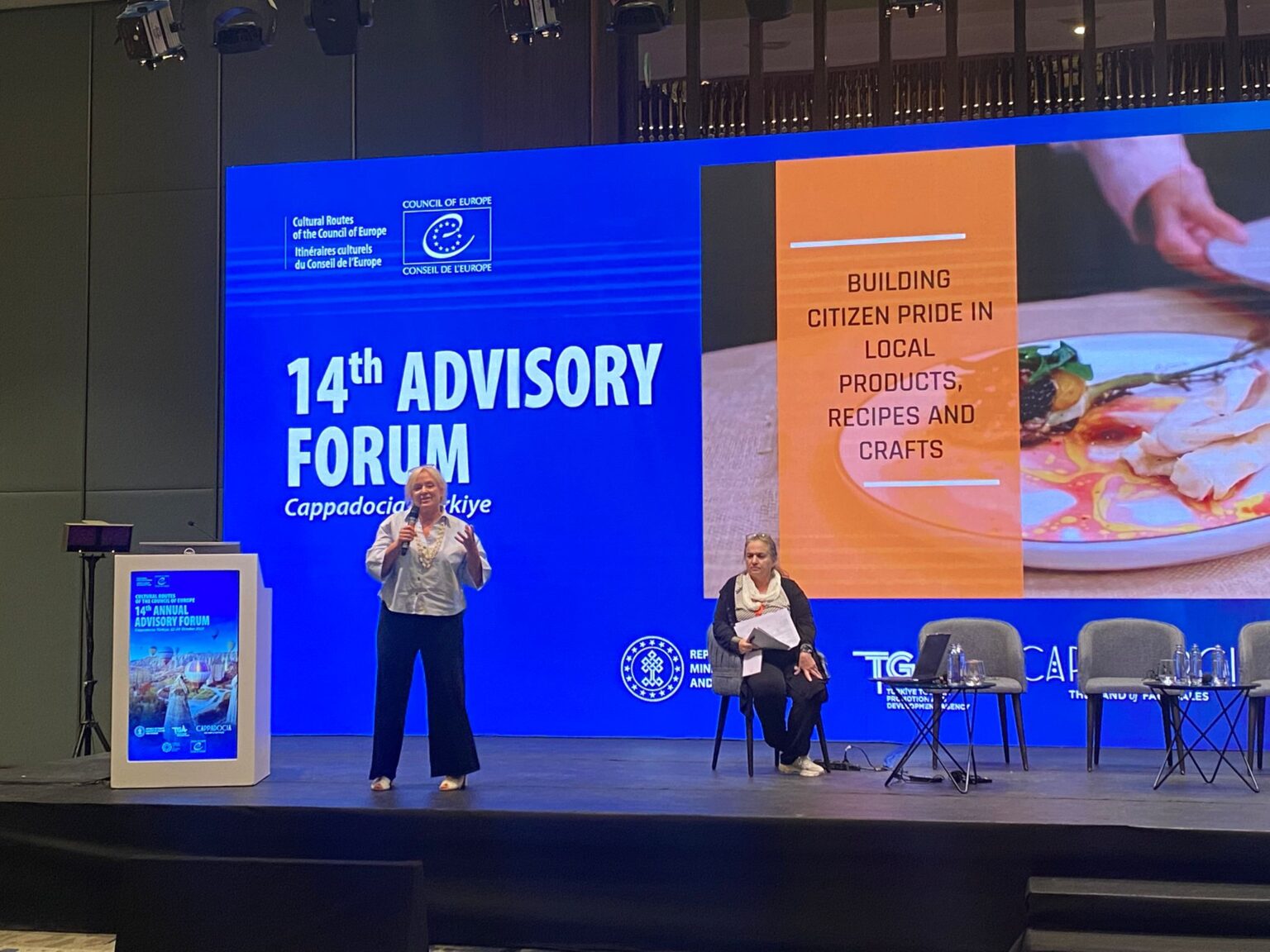
The International Institute of Gastronomy, Culture, Arts and Tourism was honoured to participate in the 14ᵗʰ Advisory Forum on Cultural Routes, held in the breathtaking region of Cappadocia, Türkiye. The Forum, organised by the Council of Europe and hosted by the Ministry of Culture and Tourism of Türkiye, was officially opened by Mr. Ali Fidan, Governor of Nevşehir, and Mr. Nadir Alpaslan, Deputy Minister of Culture and Tourism.
The Opening Session set the tone for the discussions on landscapes as a living expression of democracy and culture. Irena Guidikova, Head of the Department for Democratic Institutions and Freedoms at the Council of Europe, underscored the institutional commitment to recognising landscapes as a democratic and cultural dimension of human rights.
In her keynote address, Maguelonne Déjeant-Pons, Executive Secretary of the European Landscape Convention, reminded participants of the Convention’s binding framework for protection, planning, and participation, and its critical role in shaping how societies interact with and value their landscapes.A high-level debate followed, where speakers emphasised that cultural and natural landscapes are not passive settings, but core elements of identity, connectivity, and heritage for the Cultural Routes of the Council of Europe.
Peter de Brine, representing UNESCO, delivered a powerful reflection on the need for respectful, humble engagement with communities when consuming culture. He urged the sector to move away from measuring success by visitor numbers and instead to focus on the meaningfulness and depth of experiences, a sentiment strongly echoed by IGCAT’s long-standing advocacy for responsible and community-centred tourism.
From the discussions and insights shared throughout the Forum, IGCAT draws several key messages for the future of Cultural Routes:
- Landscapes must be reclaimed from being “cross-sectoral and no one’s responsibility”. They deserve a dedicated place within route governance. Since its foundation in 2010, IGCAT has proudly championed the central role of landscapes in shaping identity and cultural continuity.
- Food and landscape are inseparable. The vitality of gastronomic heritage depends on healthy, well-managed landscapes. To safeguard biodiversity and cultural diversity, we must go beyond sustainability towards regenerative landscapes.
- Cultural Routes can become powerful ambassadors for food-landscape awareness, integrating agricultural stewardship, local food systems, and landscape metrics into their strategies.
- Route certification, funding, and management frameworks should include landscape and food criteria as essential benchmarks, not optional add-ons.
Representing IGCAT, Dr Diane Dodd delivered a keynote that highlighted the need to better integrate food and landscape into Cultural Routes governance. She applauded inspiring examples already emerging from the Routes of Emperor Carlos V, St Olav’s Way, Via Francigena, Napoleon Route, and Phoenician Route, each creatively connecting visitors with local gastronomy and community life.
Dr Dodd also presented three IGCAT-led initiatives that celebrate the link between food, people, and place:
- Food Film Menu, which showcases short films that tell stories of local food heroes and transports them around the globe;
- World Food Gift Challenge, highlighting landscape linked gifts that preserve culinary and crafts traditions as well as contemporise them to new markets;
- Top Foodie Websites, which recognise platforms promoting authentic food experiences, supporting micro-enterprises, preserving traditions and diversifying economic possibilities in rural communities.
IGCAT invited Cultural Routes to join or adapt these initiatives to celebrate and give visibility to the true heroes sustaining local food systems.
Dr Dodd’s closing message was a call to action that resonated deeply with the Forum’s spirit. She noted that “We need to build stronger bridges between food, land, heritage, and community. This is no longer optional, it is urgent. By embracing regenerative tourism, Cultural Routes can value communities, protect landscapes, and strengthen the living link between culture, food, and heritage.”
The 14ᵗʰ Advisory Forum once again proved the importance of dialogue and collaboration between cultural institutions, policymakers, and civil society. IGCAT looks forward to continuing to support the Council of Europe’s Cultural Routes Programme in its mission to promote cultural cooperation, sustainable development, and intercultural understanding, through the shared values of food, landscape, and community.