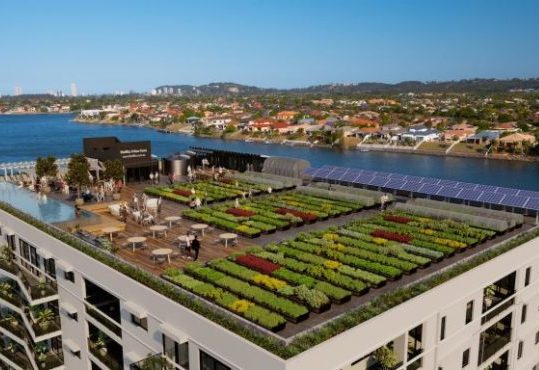
Over half the world’s people now lives in cities, an extraordinary statistic given that in 1900, just over a century ago, only 10% of the population was urban. And the trend is continuing in the same direction: Predictions estimate that 75% of us will be city-dwellers by 2050. The roots of this anthropological upset lie in the very idea of progress, in that paradigm of infinite, rule-free growth that dominates the West: Modernity is by definition urban. The rural and natural are disappearing from our lives and everything that lies outside the metropolitan area is swallowed up and transformed into mere function, answering to the city’s needs, or rather adapted to the urban organization of the world. But could we rethink the urban fabric and the metropolitan area, starting from a recovery of that lost rurality? Could we imagine and above all design our cities in a way that recolonizes with greater humanity the spaces in which modernity lives?
The industrial production model has in practice engulfed every aspect of our life, and most worryingly has relegated agriculture and rural areas to a marginal role, with a removal of the rural that is not only physical but also intellectual. This has progressed so far that agricultural areas are perceived and treated by urban and regional planning as “not yet urbanized” spaces.
What has happened? And how can we reappropriate those spaces, rural identity and agricultural knowledge that would allow us to tackle the challenge of an urbanized future at the mercy of a dramatically changing climate?
Read full original article at slowfood.com