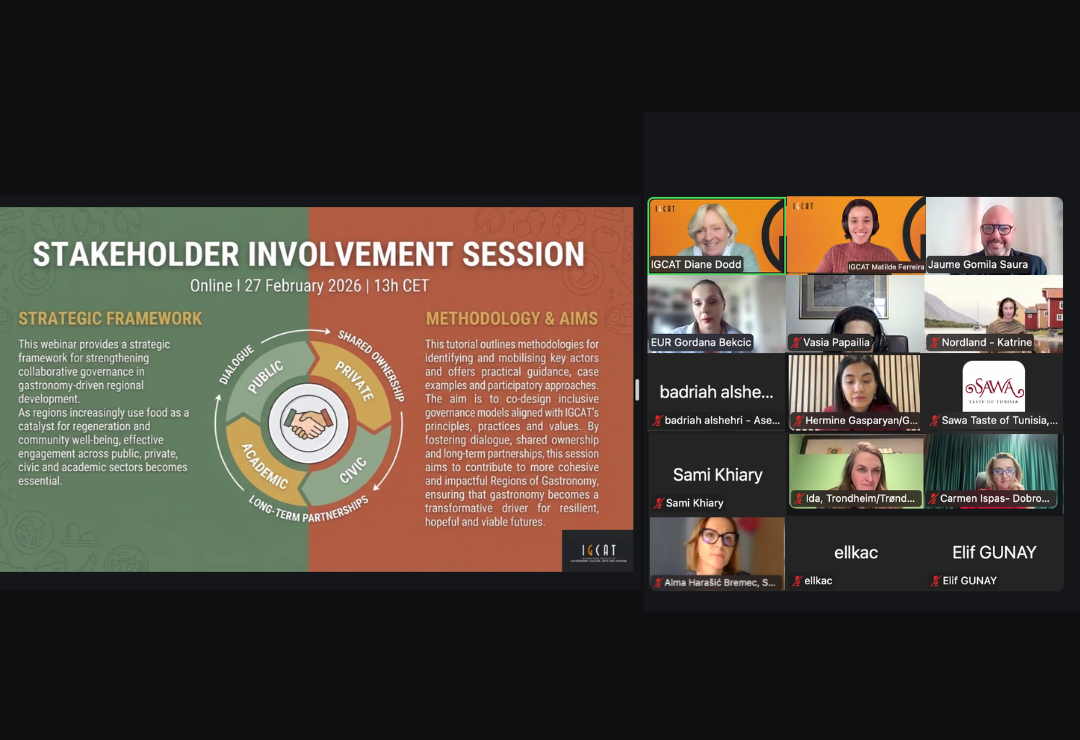
Food is more than nourishment, it is memory, landscape, identity and the possibility to regenerate a region. During a dynamic tutorial on Stakeholder Involvement for members of the World Region of Gastronomy Platform, Jaume Gomila, IGCAT Vice-President, invited members to reflect on how shared ideas can translate into lasting impact. How can regions build alliances that are not symbolic, but structural? How can collaboration across public institutions, private enterprise, civil society and academia lead to tangible transformation on the ground? The conversation moved from principle to practice, offering concrete approaches for turning dialogue into action.
At the core of the exchange was a fundamental challenge: how to connect public, private, third sector and academic stakeholders within a strong and coherent governance structure capable of delivering real solutions for the region. The focus was not simply on cooperation, but on designing systems where responsibilities are shared, trust is built, and long-term vision replaces short-term projects. Members explored how inclusive governance models, aligned with IGCAT’s values and practices, can create the conditions for meaningful and regenerative change.
Jaume Gomila placed particular emphasis on regeneration in this online webinar, noting the benefits of being a European or World Region of Gastronomy to align and strengthen the region from an environmental, cultural, social and economic perspective. Gastronomy, he stressed, must not only sustain, but actively restore. It should revive biodiversity, protect landscapes, revalue local knowledge, strengthen community bonds and renew regional ecosystems. In this vision, food becomes both catalyst and compass: a regenerative force capable of guiding regions toward resilience, wellbeing and systemic transformation.
Drawing from his experience with Menorca European Region of Gastronomy 2022, Jaume shared concrete examples of how local engagement can be mobilised effectively. His insights offered practical inspiration for regions navigating the complexities of multi-stakeholder involvement, demonstrating that successful governance grows from local perspectives, deep community understanding and clearly demonstrated social, environmental and economic benefits.
Present in the session were representatives from: South Aegean, European Region of Gastronomy 2019; Trondheim-Trøndelag, Eur
IGCAT sincerely thanks Jaume Gomila and all members for their commitment, openness and drive. Together, the World Region of Gastronomy Platform continues to shape governance models where gastronomy is not only celebrated, but mobilised as a regenerative force for resilient regions and hopeful futures.
About the World/European Regions of Gastronomy
World Regions of Gastronomy, and European Regions of Gastronomy, guided by IGCAT, are working together to strengthen food security through the celebration of distinctive food cultures; create employment by stimulating creativity and gastronomic innovation; nourish children and adults through culinary and cultural education; driving environmental sustainability in tourism, hospitality and agricultural sectors; supporting balance and sustainable tourism practices; highlighting and supporting expertise from within rural and urban communities, creating connections and sharing good practices; and contributing to community health and well-being.
About IGCAT
International Institute of Gastronomy, Culture, Arts and Tourism (IGCAT) aims to empower local communities by raising awareness of the importance of protecting and promoting distinct regional food, culture, arts and natural assets as part of sustainable and balanced tourism and development strategies. This is essential to safeguarding our planet, health, wellness and local economies.
IGCAT is a non-profit institute established in 2012, working with regional stakeholder consortiums in the fields of gastronomy, culture, arts and tourism. It counts on the expertise of a worldwide network of experts and works in partnership with specialised intergovernmental organisations.
IGCAT founded the World/European Region of Gastronomy Award and is the official secretariat for the World Regions of Gastronomy and European Regions of Gastronomy Platforms. Furthermore, the Institute has developed the European Young Chef Award, the World Food Gift Challenge, the Top Foodie Websites and the international Food Film Menu.